September is a time full of big changes for families with children of all ages, and that was true for the littlest group at RisingOaks St Matthew as well. The toddler room welcomed an almost entirely new class of children – many of whom had rarely been away from their parents for an extended period of time. Needless to say, this was a transition that brought great excitement, but also some understandable feelings of stress as our new friends take the time they need to get comfortable in this new environment.
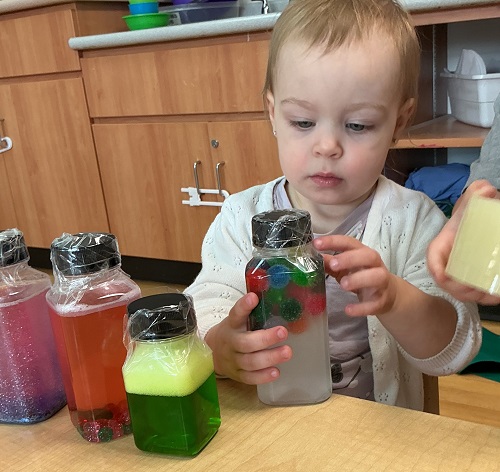
Among the many toys and materials available in our learning centres, we have sensory bottles that were handmade with the participation of a previous group. Sensory bottles, also sometimes referred to as calm down bottles or discovery bottles, are wonderful aids for self-regulation that can be effective for children across all ages and stages. Occupational Therapist Ashley Rabell writes in her article Sensory Bottles: A Creative and Calming Tool for Children’s Development that they are “powerful tools that promote emotional regulation, focus, and creative exploration. … Sensory bottles are used to help children calm down, engage their senses, and develop cognitive and motor skills – all while having fun.”
While this grand transition from home to childcare creates an obvious need for tools the children can access to soothe their nerves, emotional regulation is a skill that will truly only begin to develop in the toddler years. From day to day a significant part of the learning that will occur in our classroom involves helping children discover their internal ability to recognize and name their at times big and overwhelming emotions, then identify some of the tools within reach that can aid them in returning to a state of calm. As such, sensory bottles are a material that live on our shelves and are certainly freely available to be explored and played with even when the children are already calm. This has the additional benefits of preventing a negative association from forming in the children’s mind (as they may not be happy to see materials that only come out when they’re already angry or sad) and being completely child-guided as they can decide to pick one up at any time rather than having to communicate that they need one.
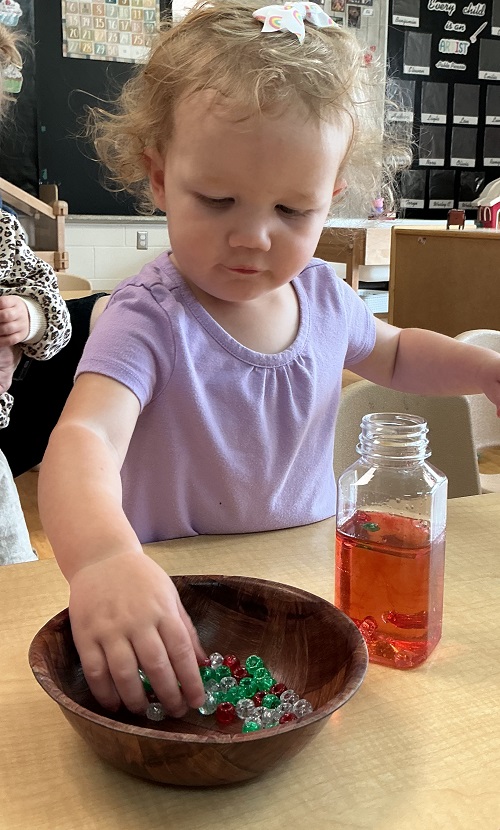
In our second week with this new group, we decided that it was time to make some fresh sensory bottles. Children always find materials more fun to use when they’re directly involved in putting them together! The toddlers were invited to join educator Eli around the table with some intriguing materials: colourful pom-poms, beads, and seashells accompanied liquid add-ins like water, dish soap, and baby oil. Everyone had a turn to put something into a bottle, practicing patience and turn-taking as well as fine motor skills required to pick up and place in the small parts. This experience also promoted a sense of community among the toddlers who are still getting to know each other because we all worked together to form the finished product.
Once the bottles were finished, the children had time to explore. They were encouraged to shake the bottles and watch how the materials inside responded. One consisted of baby oil and blue coloured water that separated again after sitting, another of pom-poms suspended in clear glue that moved slowly and needed a stronger shake. Whatever the exact materials and effect, each bottle provides unique sensory input that can assist the children in managing strong emotions so that they can get back to a place of learning and having fun.