Over the summer, the preschool children and I did a deep dive into marine biology, specifically the ocean and its inhabitants. This exploration had started after they built a creative story involving an angler fish and subsequently were hooked.
We were not surprised when our then preschoolers, but now school age kindergarteners, wanted to continue learning about angler fish and the ocean. Monique had entered our classroom chanting, “Angler fish, Angler fish!”
One of the beautiful things about our after school program is that we get to be a bridge, both for the safety, warmth, and emergent learning that happens in a preschool program and to the guided learning and new experiences that come from formal education at school.
We wanted to carry the torch and incorporate some of the skills with an ocean activity that they will use in the coming years, such as:
- Representation
- Memory
- Vocabulary
and most importantly,
- A Positive Attitude Towards Learning
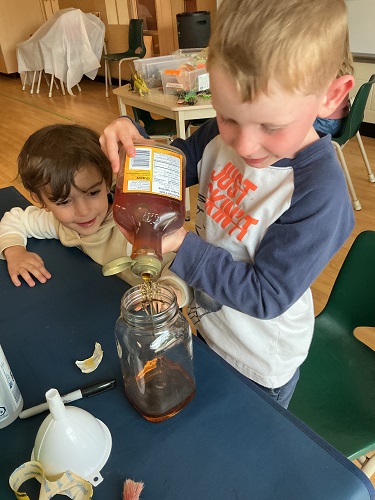
In this activity we used ingredients with different densities, such as:
- Corn Syrup
- Rubbing Alcohol
- Vegetable Oil
- Water
- Dish Soap
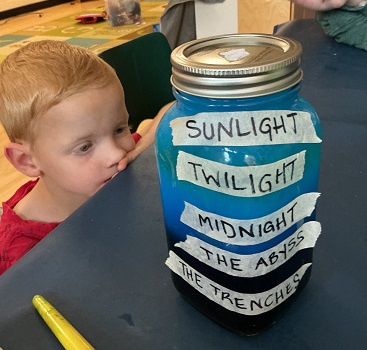
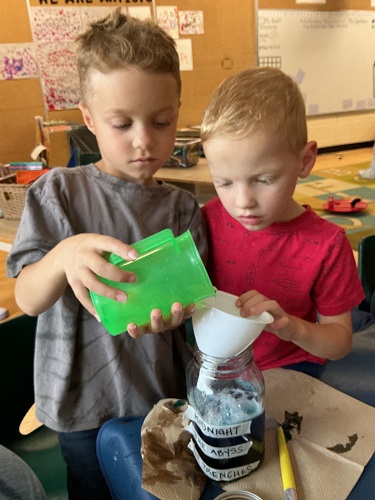
We measured each of the ingredients into our large, clear mason jar. We added corn syrup to the bottom, then blue dish soup, then water with blue food colouring, then oil, and finally, rubbing alcohol (of course the educators added this last layer). We used masking tape and labelled each of the layers into their correct zones. Starting from the top, they were labelled as:
- The Sunlight Zone (Epipelagic)
- The Twilight Zone (Mesopelagic)
- The Midnight Zone (Bathypelagic)
- The Abyss (Abyssopelagic)
- The Trenches (Hadalpelagic)
We talked with the children about what animals live in each zone so each attributed organism can help them remember the individual layer. We used the following examples:
- The Great White Shark (The Sunlight Zone)
- Shrimp (The Twilight Zone)
- The Sperm Whale and Angler Fish (The Midnight Zone)
- The Colossal Squid (The Abyss)
- Sea Cucumbers (The Trenches)
When our layers had been solidified, Katelyn asked what would happen if we shook it all together? Her Dad had been there to help in the creation and suggested that he thought they might separate back into their layers! We asked the children and the table was split about if the layers would go back to normal, but were unanimous about wanting to shake the jar.
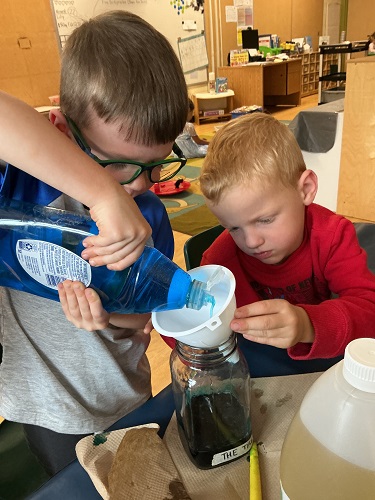
We shook the jar and the children watched as the blue food colouring combined across all layers, then they sat and watched as the “ocean” tried to recalibrate and redistribute.
We left the jar overnight and the following day observed how the layers had primarily (minus the blue food colouring and water/soap) separated. We asked the children why they thought some of the layers had divided again. Katelyn and Grayson suggested that some of the layers were scared of the water, just like we had talked about in our previous oil and water activity to understand hydrophobic properties! We also asked them if they thought that some of the layers might be heavier than others, like comparing the corn syrup and rubbing alcohol? They confidently said yes and started to suggest other things that would sink to the bottom, like rocks, and water bottles!
Their excitement and engagement for this activity has been inspiring and we plan on continuing our ocean/STEM exploration. First up, we will be creating a large scale sink or float activity next week, so be sure to watch out for that! Do you have any suggestions of items we could experiment with?