
As we begin a new school year, the children are settling back into the program, reconnecting with old friends and beginning to build relationships with new ones. Throughout these first weeks, we have noticed a strong interest in group activities. These shared experiences have provided opportunities for children to communicate, collaborate, problem-solve and develop a sense of belonging within the group.
For our returning children, familiar activities have helped them reconnect after the summer. For children who are new to the program, these same experiences have provided a natural way to enter into play, meet their peers and become comfortable within their new environment.
The Playstix have been especially popular among a group of boys. The children have been using the pieces to build a variety of creations, experimenting with different ways of connecting, balancing and arranging the materials.
What has been interesting to observe is how their building often develops into dramatic play. Once a structure is created, the children begin giving it meaning and incorporating it into their imaginative play. What starts as a construction experience quickly becomes an opportunity for storytelling, creativity and shared ideas.
As the children build together, they are developing spatial awareness and problem-solving skills while learning through trial and error. When a structure does not work the way they expected, they adjust and try again. At the same time, they are learning how to share materials, communicate their ideas, listen to the ideas of others and negotiate how their play will continue.
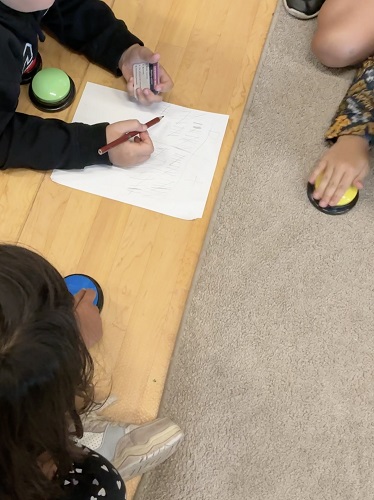 Another activity that has quickly become popular with all of the children is the Family Game Show Buzzers. The game includes individual buzzers and cards that can be used for matching colours or, for older children, identifying letters
 and thinking of words that begin with those letters. One morning, I noticed a group of children gathered around the game, but they were not following the instructions. Instead, they had created an entirely new game that reminded me of Family Feud. Each child had their own buzzer. One child took on the role of asking trivia questions, and l kept a tally of the scores. When someone knew the answer, they had to quickly hit their buzzer.
This was a great example of the children taking ownership of their play. They independently created rules, assigned roles and organized an experience that allowed everyone to participate. The questioner was developing confidence, communication and leadership skills, while the children answering were practicing listening, memory and quick thinking.
The children also had to practice patience, turn-taking and fairness as they worked through disagreements about who buzzed first or whether an answer was correct. Rather than an educator directing the experience, the children were working together to determine how their game should operate.
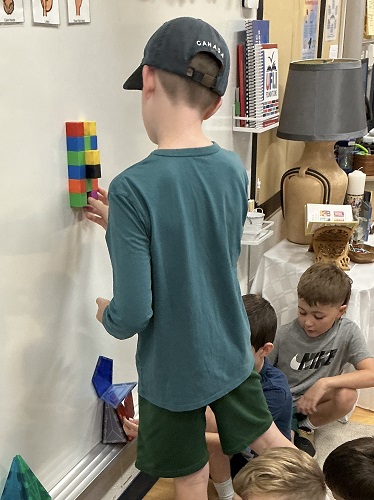
Another activity that has continued from last school year involves the magnetic tiles and magnetic cubes on the whiteboard.
The children create magnetic structures and place animals onto their creations. They then challenge their structures by “attacking” them with another magnetic tile to see if the structure and animals will remain attached to the board.
This experience has encouraged the children to experiment with balance, weight, strength and magnetic force. They make predictions about whether their structures will hold and quickly discover that sometimes their original design needs to be changed. When something falls, they rebuild, adjust and try again, demonstrating persistence and flexible problem-solving.
One of the most meaningful observations this year has been seeing children who are new to our program joining this activity. Returning children already understand the game and have naturally begun showing new children how it works.
The activity has therefore become more than a building challenge. It has become a way for returning children to share their knowledge and for new children to become part of the group. The children are learning from one another and building relationships through a shared interest.
After observing how much the children were enjoying activities involving groups, challenges and friendly competition, Lisa, the educator, introduced a new cooperative challenge.
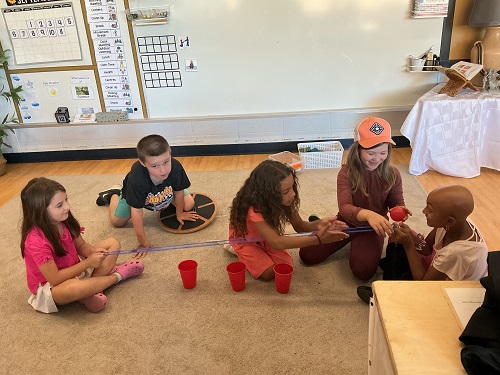
Three cups were placed in a row. Two children sat across from one another, each holding two strings, one in each hand. Another child placed a ball on top of the strings on the side of the person attempting the challenge.
The goal was to carefully manipulate the strings to guide the ball into one of the cups. Once the ball successfully landed in a cup, that cup was flipped over and the children continued until they had successfully completed all three cups.
The children quickly discovered that getting the ball into the cups required concentration and control. They needed to watch the movement of the ball, adjust the strings and think about how their movements affected where the ball travelled.
Children watched and encouraged one another, celebrated when someone successfully landed the ball and learned that missing the cup simply meant adjusting their strategy and trying again.
These moments of shared excitement and encouragement have been especially valuable during the beginning of the school year. Children who may not know one another well yet are finding common experiences that allow them to interact without the pressure of having to immediately form a friendship.
As we continue into the school year, educators will build on the children’s growing interest in construction, group challenges, competition, collaboration and team building.
Educators will continue to listen closely to children’s conversations and use open-ended questions such as “How did you come up with that idea?” “What do you think will happen?” “What could you try differently?” and “How could we make this more challenging?” Their responses will help determine where these experiences go next.
As we move further into the school year, our focus will continue to be on creating an environment where every child feels safe, included and welcome. These first weeks have already demonstrated how naturally children build community through play.